

Etsy doesn't make the crafts. Fiverr doesn't do the gigs. Airbnb doesn't own a single room.
They just bring buyers and sellers together, and take a small cut of every deal.
That's the magic of a multi-vendor marketplace. Vendors bring the products, services or rentals. You run the platform and earn on every sale. No stock, no shipping, no team of freelancers to manage.
The good news? You no longer need $50,000 and a team of developers to build one. Here are the 9 best multi-vendor marketplace software platforms in 2027, with honest pros, cons and prices.
What Is Multi-Vendor Marketplace Software?
It's software that lets many independent sellers list and sell on one website that you own.
Each vendor gets their own storefront or profile. Buyers browse everything in one place, pay through your site, and leave reviews. The software handles the hard parts, like vendor signups, orders, payouts, commissions and disputes.
Think of it as the engine behind sites like Etsy, Fiverr, TaskRabbit and Turo, ready for you to use in your own niche.
Why Start a Marketplace in 2027?
Marketplaces are one of the few online businesses that get easier as they grow.
- No inventory. Vendors own the products and deliver the services.
- Low running costs. You pay for software, not warehouses.
- Free content. Every vendor listing is a new page Google can find.
- Network effects. More sellers attract more buyers, and more buyers attract more sellers.
- Many ways to earn. Commissions, fees, subscriptions and paid placements.
And there are still thousands of niches with no good marketplace. A local home services directory. Camera gear rentals in your city. A hub for handmade pet products. Small, focused marketplaces often win because the big ones ignore them.
How a Marketplace Makes Money
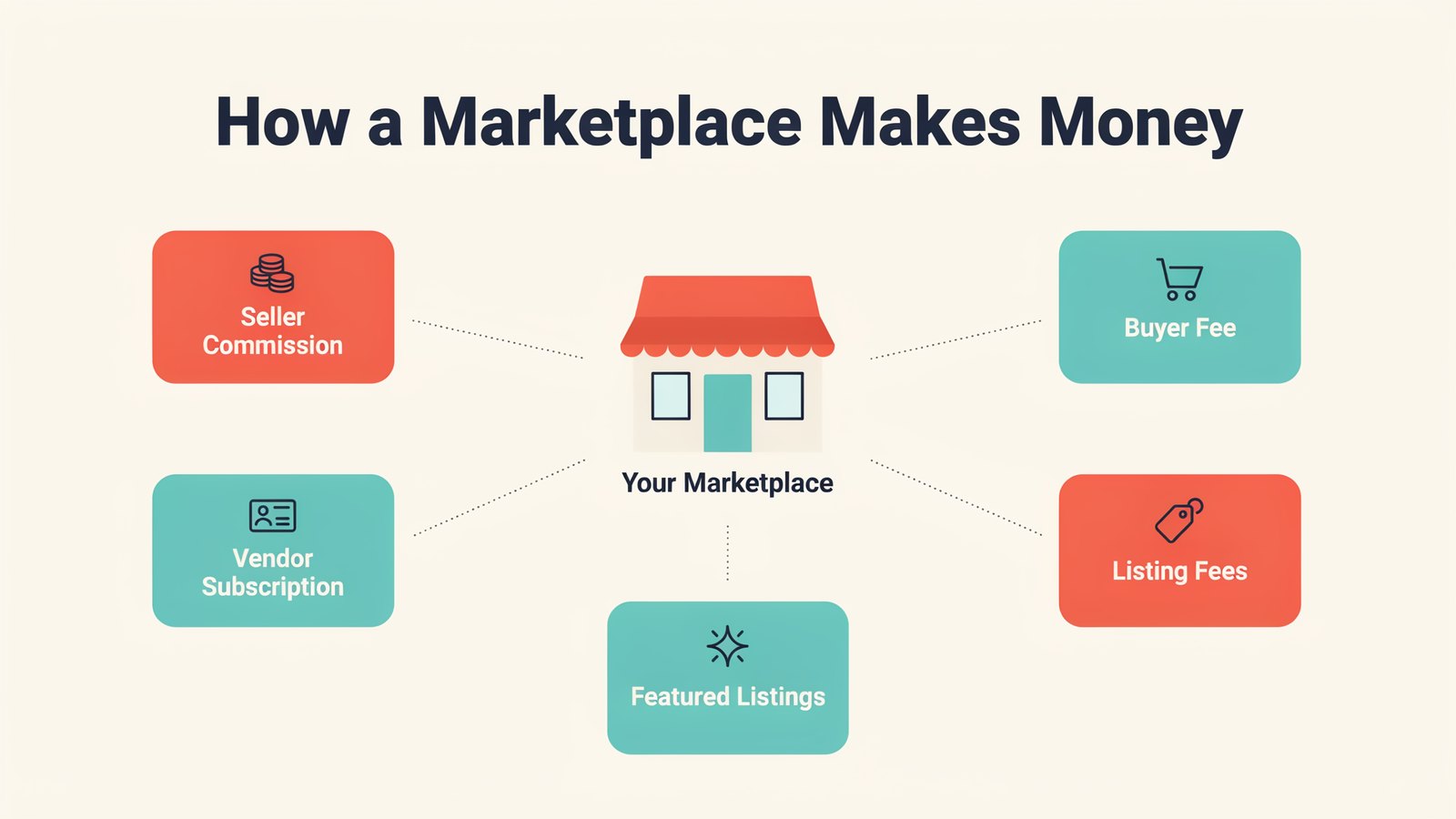
Most marketplace owners mix two or three of these.
- Seller commission. Take a percentage of every order, often 10 to 20 percent.
- Buyer fee. Add a small service fee at checkout, like Airbnb and Fiverr do.
- Vendor subscription. Charge sellers a monthly fee to list on your site.
- Listing fees. Give a few listings free and charge for more.
- Featured listings. Charge vendors to appear on the home page or at the top of search.
A quick example. A local marketplace doing $20,000 a month in sales at a 15 percent commission earns $3,000 a month. That's before any fees or paid listings.
What to Look For in Marketplace Software
- The right model. Products, digital goods, services, rentals or all four.
- Hosting. Hosted platforms are faster to launch. Self-hosted ones give more control but need a developer.
- Vendor tools. Easy onboarding, dashboards and payouts keep sellers happy.
- Commission control. You should set how much you earn and how.
- Moderation. Someone has to stop spam, scams and fake listings.
- Total cost. Look past the sticker price. Add hosting, plugins, themes and transaction fees.
Quick Comparison
| Software | Best For | Hosting | Starting Price |
|---|---|---|---|
| Martsi | Launching any marketplace fast on a small budget | Hosted | $5.58 a month, paid yearly |
| Sharetribe | Funded startups that want no-code plus custom code | Hosted | $39 a month to build, $199 a month live |
| CS-Cart Multi-Vendor | Large product marketplaces | Self-hosted or managed | $725 a year |
| Dokan | WordPress and WooCommerce users | Self-hosted | Free, Pro from $149 a year |
| MultiVendorX | WordPress rental, booking and B2B marketplaces | Self-hosted | Free, Pro from $149 a year |
| Webkul Multi Vendor | Shopify store owners | On Shopify | $30 a month plus Shopify |
| Yo!Kart | Owning the source code with a one-time fee | Self-hosted | $1,999 one-time |
| Arcadier | Companies adding a marketplace to an existing business | Hosted | Custom quote |
| Mirakl | Big retailers and enterprise brands | Hosted | Custom quote |
1. Martsi
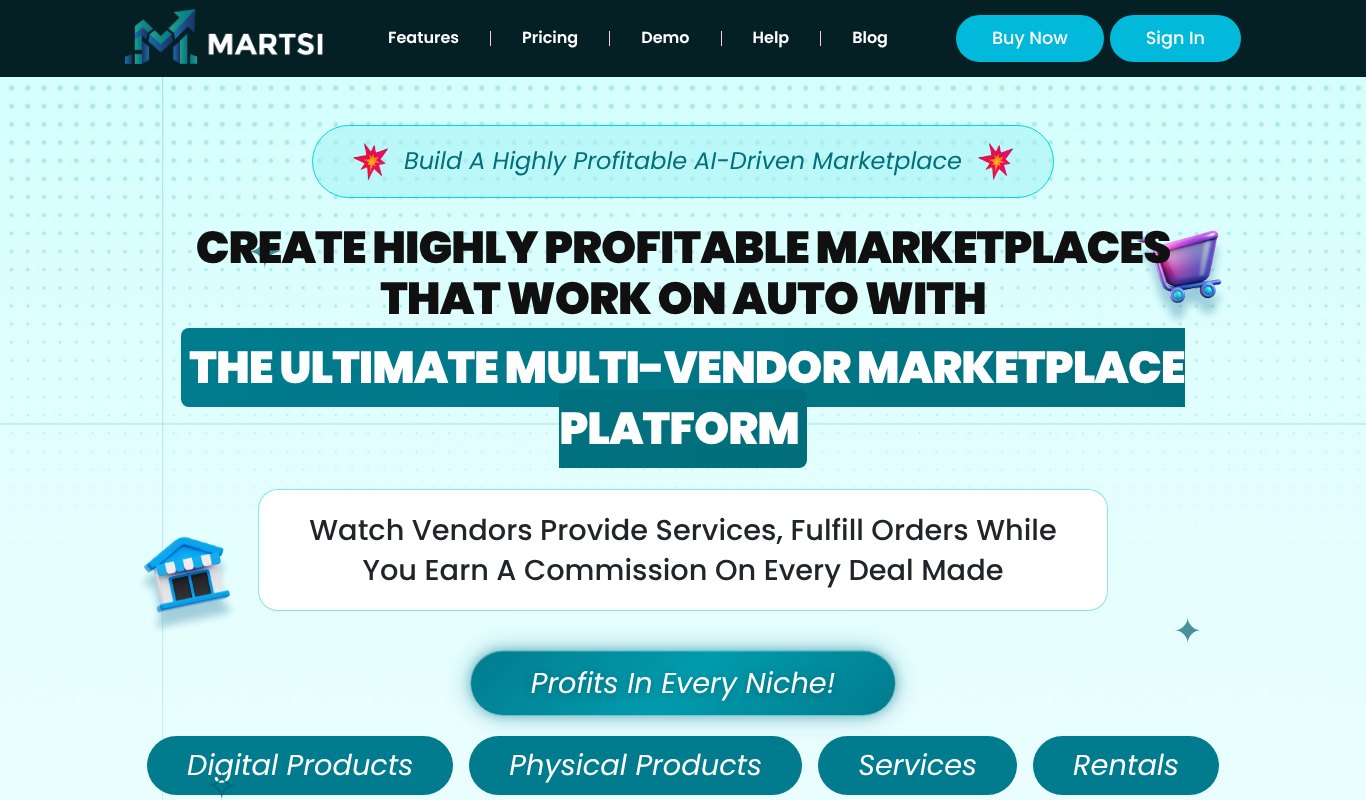
Martsi is an AI-powered marketplace builder from Teknikforce. It's made for regular entrepreneurs who want a working marketplace without hiring developers.
What makes it stand out? It handles all four marketplace models in one platform. Physical products like Etsy. Digital products like Gumroad. Services like Fiverr and TaskRabbit. Rentals like Airbnb and Turo.
You pick a model, set your storefront and commission rates, and go live. The team says most people launch in about 20 minutes.
Then the AI takes over the boring parts. It screens new listings for spam and scams before they go live. It watches messages for abuse. It even blocks buyers and sellers from swapping phone numbers or emails, so deals stay on your site and you keep your commission.
Vendors get AI help too. A built-in copy tool polishes their titles and descriptions, which means better listings and more search traffic for you.
There's also a Martsi MCP connection, so you can pull orders, approve vendors and handle disputes right from Claude or ChatGPT.
Everything is hosted for you. Point your own domain at it, choose a theme, and you're running.
Best for. Entrepreneurs, agencies and local businesses who want to launch a products, services or rental marketplace quickly, without a big budget.
Price. $5.58 a month, paid yearly ($67 a year), or $6.99 month to month. The plan includes 1 marketplace, up to 200 sellers, 4,000 buyers and 600 products, with a 30 day refund.
Pros
- Products, digital goods, services and rentals in one tool
- AI moderation for listings and messages
- AI contact info filter protects your commissions
- Seven ways to earn, from commissions to ads and dispute fees
- Hosted, with custom domains and themes
- Built-in email broadcasts to your buyers and vendors
- By far the lowest price on this list
Cons
- The starter plan caps sellers, buyers and products
- Newer than long-running platforms like CS-Cart
Why Martsi Is the Best Value
Look at the rest of this list. Sharetribe costs $199 a month once you go live. CS-Cart starts at $725 a year before hosting. Yo!Kart wants $1,999 up front.
Martsi costs $67 a year.
That's hosting, AI moderation and all four marketplace models included. For anyone testing a marketplace idea, it removes almost all the money risk. If the idea works, you've spent very little. If it doesn't, you've lost less than a nice dinner.
2. Sharetribe
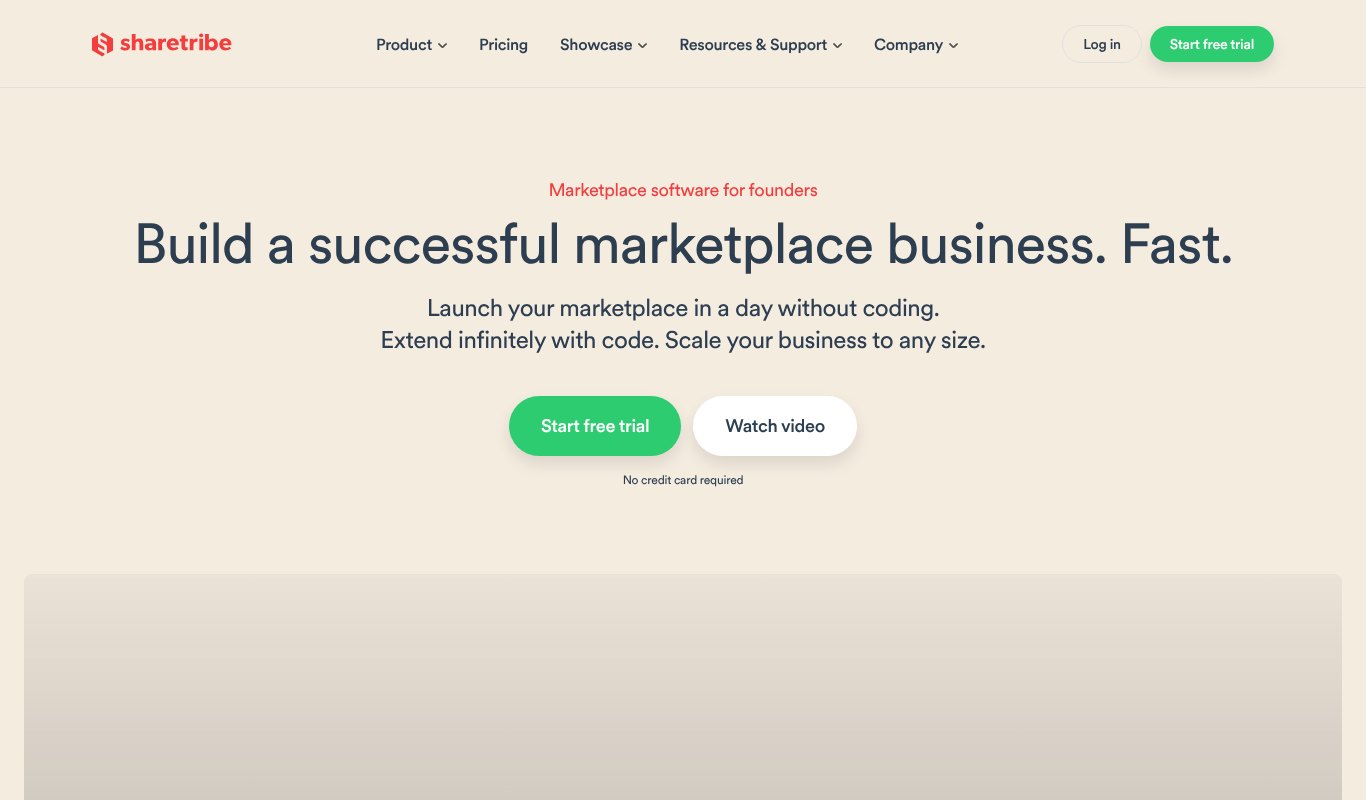
Sharetribe is one of the best-known marketplace builders. It's popular with startups building rental, service and booking marketplaces.
You can launch with its no-code tools, then hand the project to developers later. They get full code and API access to build almost anything on top.
It doesn't take a cut of your sales, which is nice as you grow. But you pay a solid monthly fee from day one of going live.
Best for. Funded founders who want to start no-code and grow into a custom-built marketplace.
Price. $39 a month on the Build plan while you set things up and test. Going live costs $199 a month, billed yearly. There is a 14 day free trial.
Pros
- Strong for rentals, bookings and services
- No-code start with full code access later
- No transaction fees
- Mature and well documented
Cons
- Expensive for small or side projects
- Extra usage is billed on top
- Physical product marketplaces need more setup
3. CS-Cart Multi-Vendor
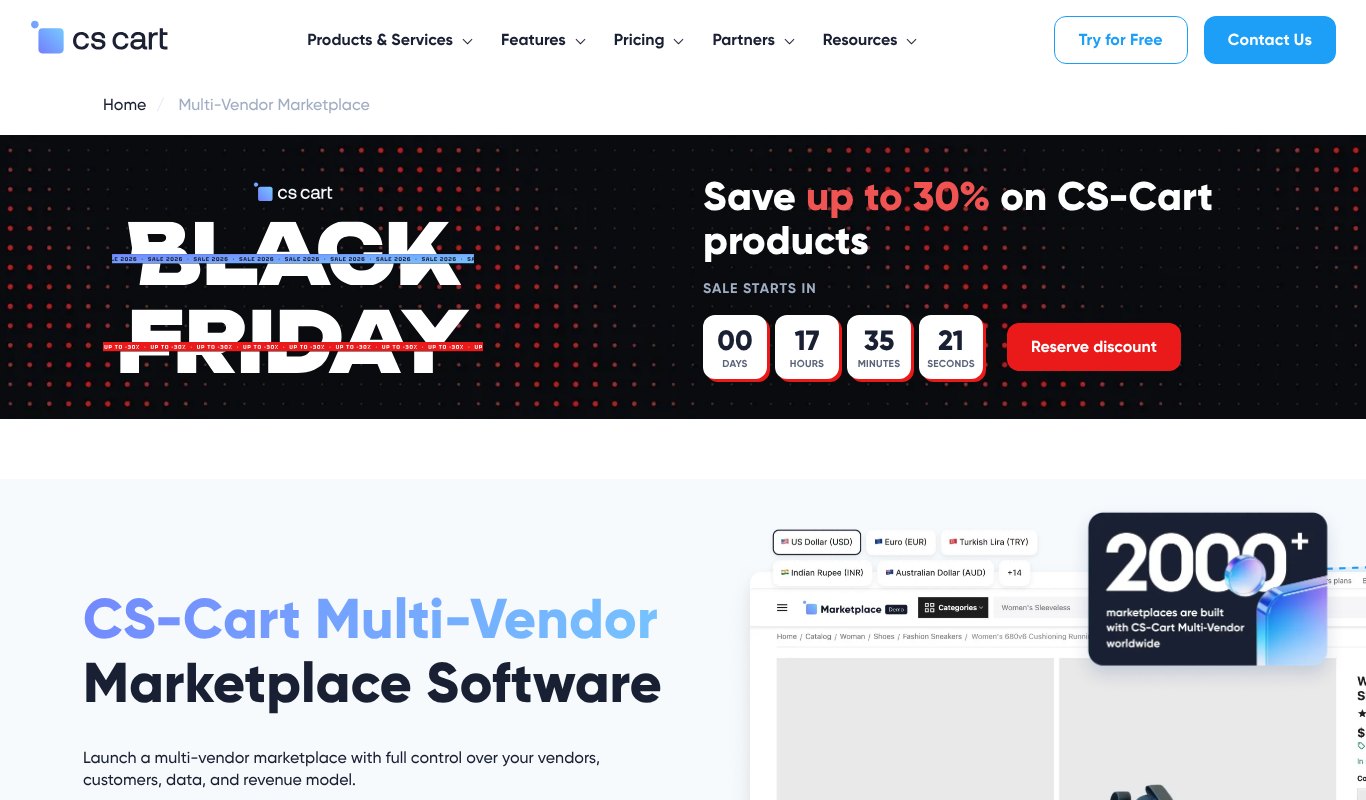
CS-Cart Multi-Vendor is a heavy-duty platform for product marketplaces. Think Amazon or eBay style stores with thousands of sellers.
It has deep features for vendor plans, shipping, taxes and payouts. There's also a mobile app option and a visual editor for the storefront.
The trade-off is complexity. Most owners need a developer or CS-Cart's own team for setup, upgrades and add-ons.
Best for. Established businesses building a large physical product marketplace.
Price. The annual subscription starts at $725 a year (about $61 a month). Lifetime licenses start at $3,590. There is a 14 day free trial.
Pros
- Very feature-rich for product marketplaces
- Full source code access
- Mobile app available
- Large add-on library
Cons
- Steep learning curve
- Hosting, add-ons and dev work cost extra
- Not built for services or rentals
4. Dokan
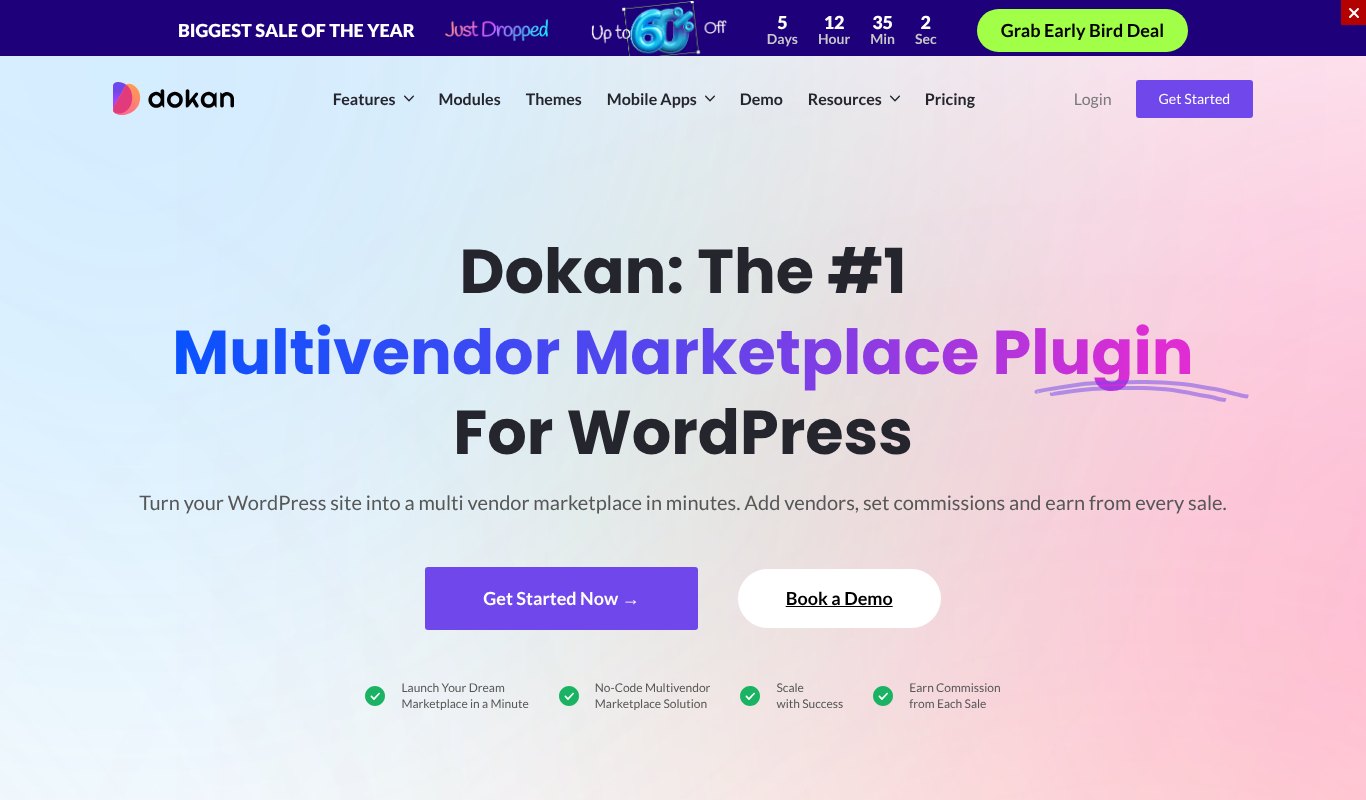
Dokan is the most popular multi-vendor plugin for WordPress. It turns a WooCommerce store into a marketplace where vendors get their own frontend dashboards.
The free version covers the basics. Paid plans add modules for subscriptions, shipping, vendor verification, auctions and more.
If you already run WordPress and know your way around plugins, Dokan feels familiar.
Best for. WordPress and WooCommerce users who want to add vendors to their store.
Price. The core plugin is free. Pro plans start at $149 a year for one site. You also need your own hosting, domain and often extra WooCommerce plugins.
Pros
- Free version to start
- Huge WordPress community
- Lots of modules and integrations
- Vendor dashboards on the frontend
Cons
- You manage hosting, updates and security yourself
- Costs add up with plugins and themes
- Can get slow on cheap hosting
5. MultiVendorX
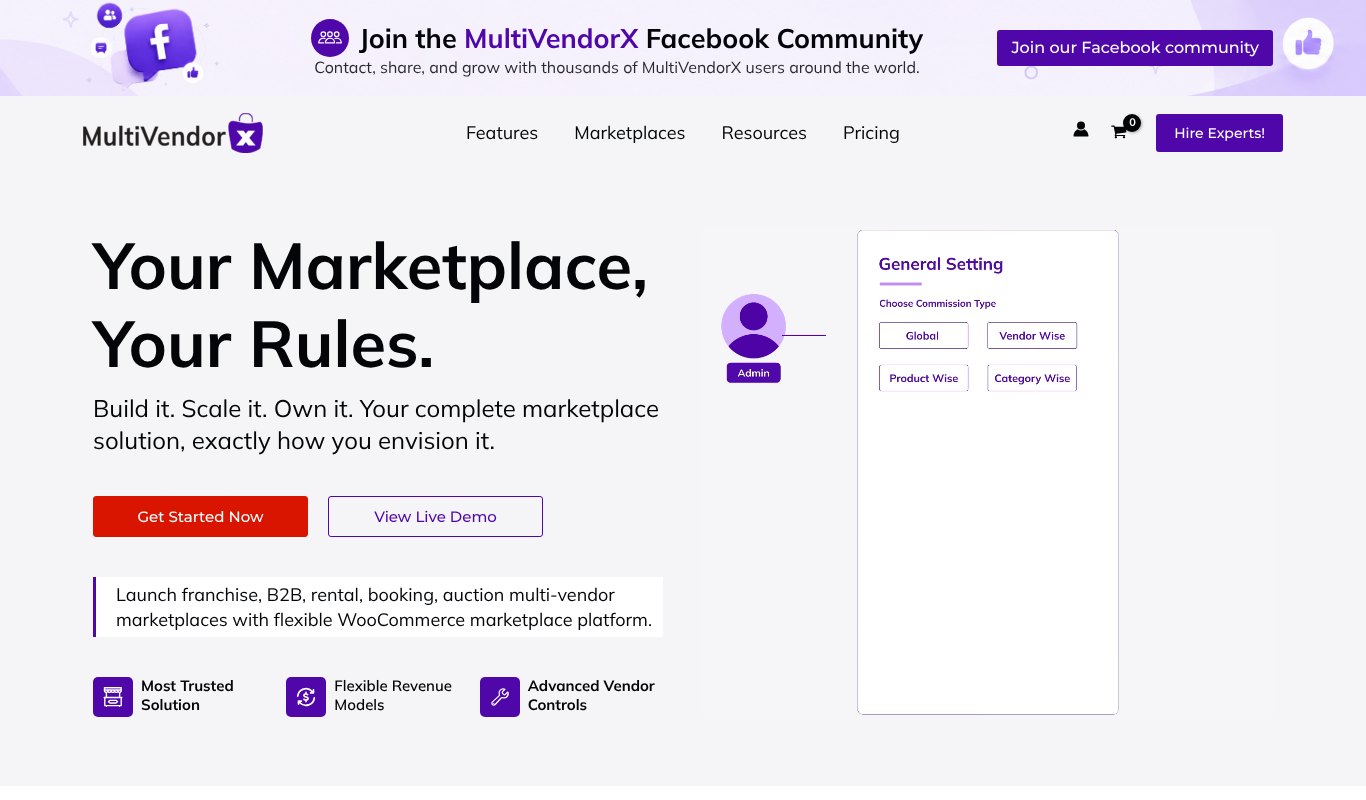
MultiVendorX is another WordPress plugin built on WooCommerce. It leans into special marketplace types like rentals, bookings, auctions and B2B.
It comes with over 50 modules, so you switch on only what you need. Commission rules can be set per vendor, per product or per category.
Like Dokan, it's a good fit if WordPress is already your home base.
Best for. WordPress users building rental, booking or B2B marketplaces.
Price. There is a free version. Pro starts at $149 a year for 1 site, $199 a year for 3 sites and $299 a year for 10 sites.
Pros
- Free version available
- Good for rentals, bookings and auctions
- Flexible commission rules
- Fair yearly pricing
Cons
- Needs WordPress, WooCommerce and hosting
- Setup takes time to get right
- Feature add-ons can feel scattered
6. Webkul Multi Vendor Marketplace for Shopify
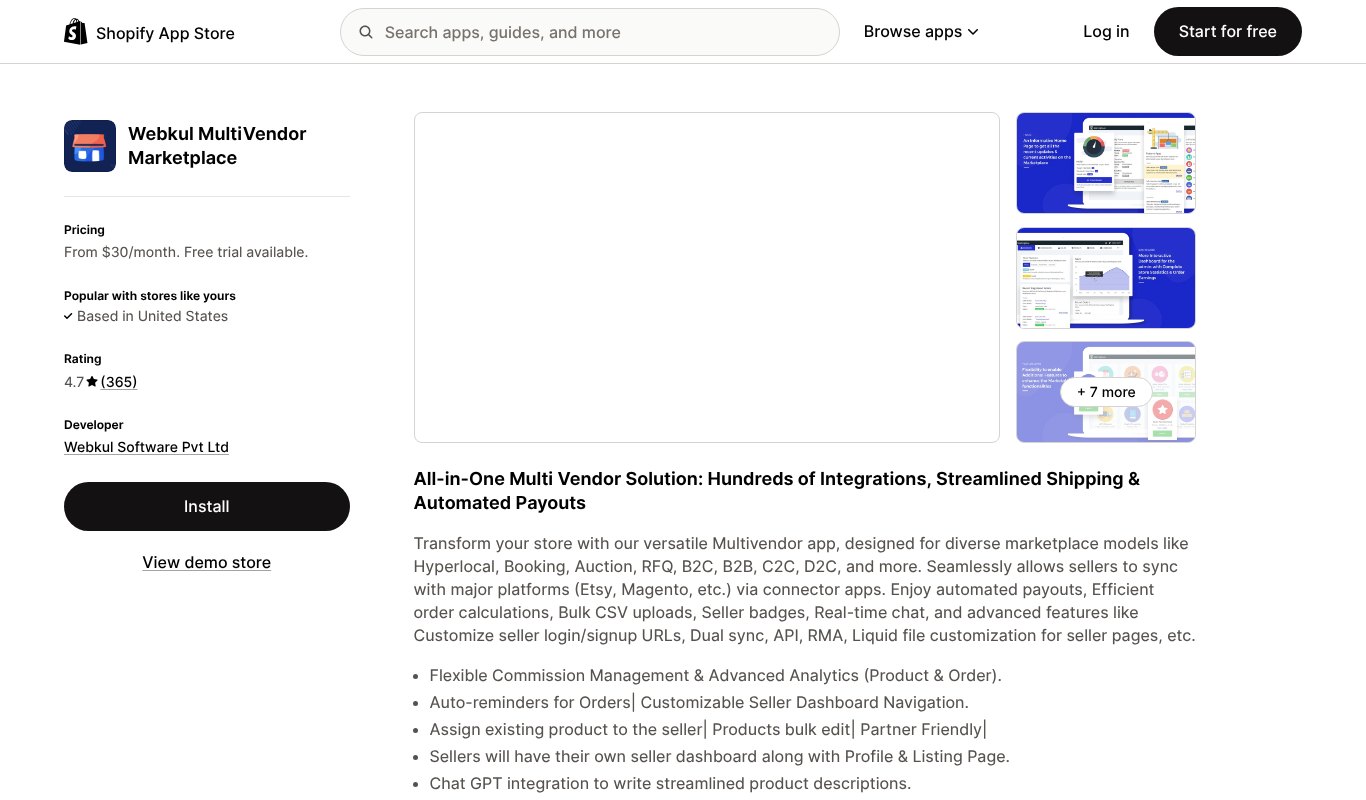
Already selling on Shopify? Webkul's Multi Vendor Marketplace app turns your Shopify store into a marketplace.
Sellers get their own dashboards, and you control commissions and payouts. It supports many models, including hyperlocal, booking, auction and B2B.
Keep in mind you pay for Shopify and the app, and many extra features are paid add-ons.
Best for. Shopify store owners who want to add outside sellers.
Price. From $30 a month ($324 a year), with higher plans at $60, $100 and $500 a month. This is on top of your Shopify plan. There is a 15 day free trial.
Pros
- Works inside the Shopify you already know
- Many marketplace models supported
- Large list of add-ons
Cons
- Two bills, Shopify plus the app
- Useful features often cost extra
- Locked into the Shopify platform
7. Yo!Kart
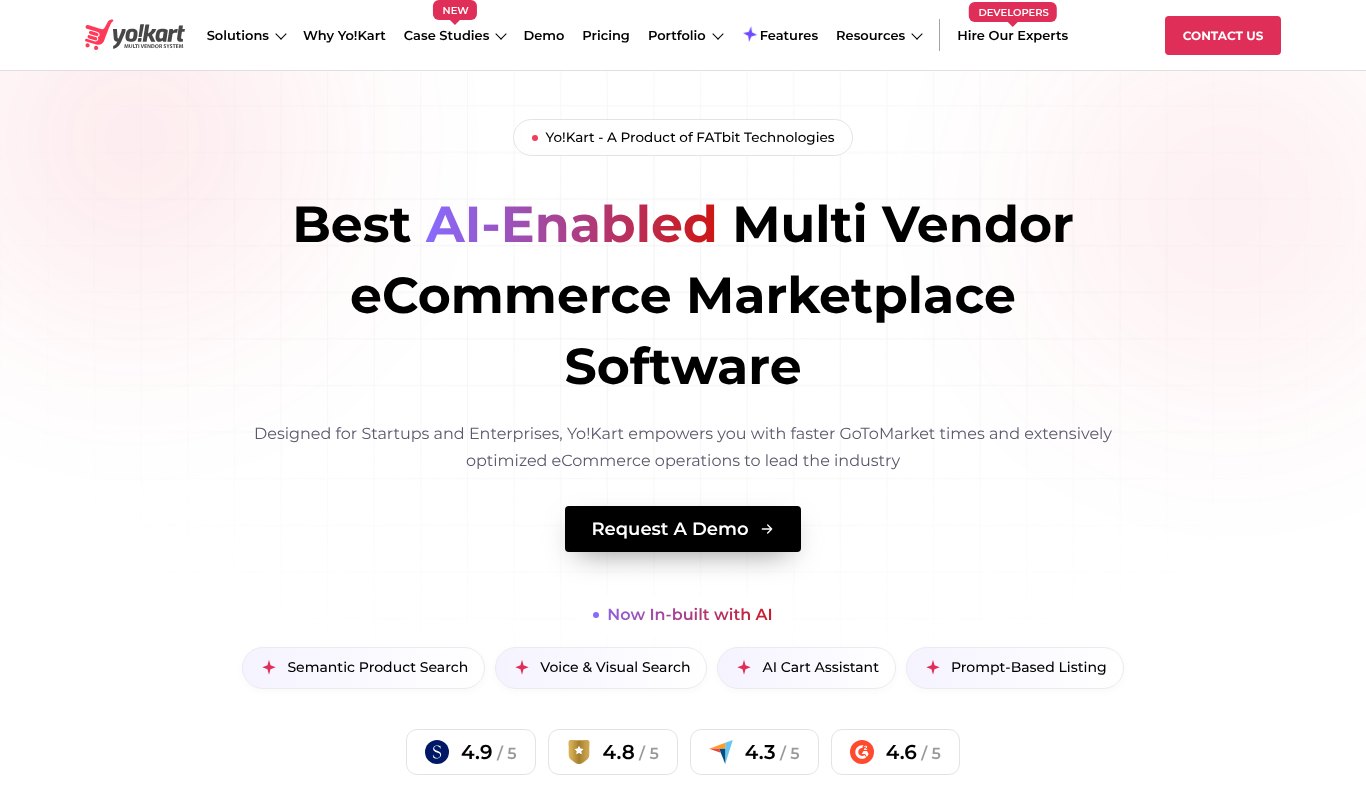
Yo!Kart sells self-hosted marketplace software with a lifetime license. You pay once and own your copy, with no monthly platform fee.
It's aimed at startups and enterprises building product marketplaces, and the team can install and customize it for you.
The catch is the upfront cost, plus your own hosting and any custom work after the first year of support.
Best for. Businesses that want a one-time license and their own customizable source code.
Price. The GoQuick package costs $1,999 one-time. GoCustom costs $6,249, and GoCustom Prime is quoted on request. Each includes 12 months of free tech support.
Pros
- One-time payment, no monthly fees
- Customizable source code
- Installation included
- Mobile apps available
Cons
- High upfront cost
- You pay for hosting and later upkeep
- Built mainly for product marketplaces
8. Arcadier
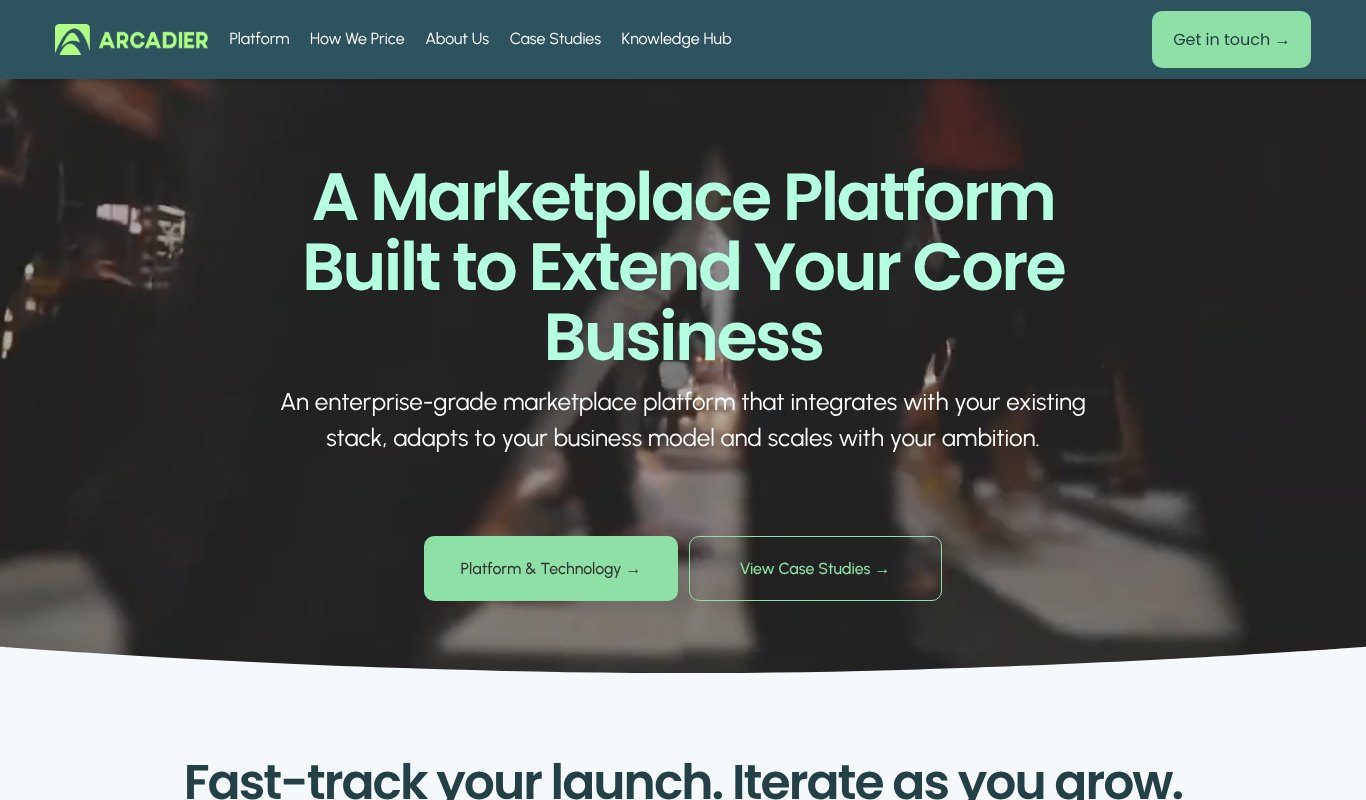
Arcadier has moved toward bigger clients. It now helps companies add a marketplace to an existing business, using its API and admin portal.
Pricing is built around your project, with a one-time setup fee, a monthly platform fee and optional managed services.
That makes it a better fit for established companies than for solo founders.
Best for. Established companies adding a marketplace alongside an existing business.
Price. Custom quote. Expect a one-time setup fee plus monthly platform and maintenance fees.
Pros
- Flexible API and admin portal
- Managed build services available
- No default transaction fees
Cons
- No public pricing
- Built for larger projects
- Slower to get started
9. Mirakl
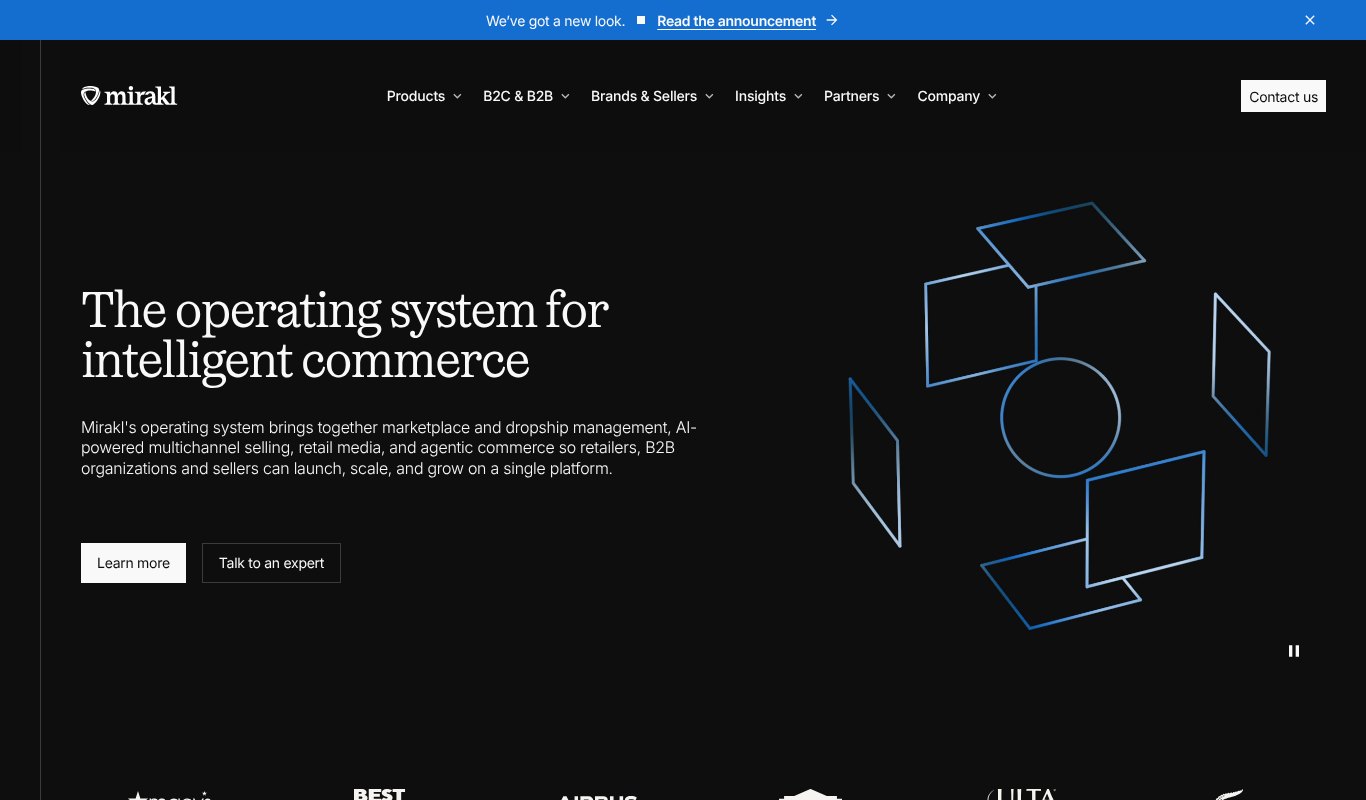
Mirakl is the enterprise choice. Large retailers and brands use it to run huge marketplaces and dropship programs with thousands of sellers.
It's powerful, with strong tools for seller management, product data and B2B selling. But it's priced and built for big companies.
Best for. Big retailers and enterprise brands with large budgets and teams.
Price. Custom enterprise pricing. You talk to sales to get a quote.
Pros
- Built for huge scale
- Strong B2B and dropship features
- Trusted by big brands
Cons
- Far too costly for small businesses
- Long setup and sales process
- Needs a dedicated team
Hosted vs Self-Hosted Marketplace Software
This is the first big choice you'll make.
Hosted platforms like Martsi and Sharetribe run everything for you. No servers, no updates, no security patches. You sign up and start building. The trade-off is that you work within the platform's features.
Self-hosted options like CS-Cart, Dokan, MultiVendorX and Yo!Kart give you the code. You can change anything. But you also pay for hosting, handle updates, and usually need a developer on call.
For a first marketplace, hosted is almost always the smarter move. You want to prove people will use it before you spend on custom code.
How to Pick the Right One
- Testing an idea on a small budget? Start with Martsi.
- Already on WordPress? Try Dokan or MultiVendorX.
- Already on Shopify? Look at Webkul.
- Funded startup planning lots of custom features? Sharetribe is a strong pick.
- Big product catalog with thousands of sellers? CS-Cart or Yo!Kart.
- Enterprise retailer? Mirakl or Arcadier.
How to Launch Your Marketplace in 5 Steps
- Pick a narrow niche. "Camera rentals in Austin" beats "rentals." Small and focused is easier to win.
- Sign up your first vendors yourself. Reach out to local sellers or freelancers and offer free early access.
- Set simple fees. Start with one commission rate. You can add paid listings later.
- Let vendors promote you. Give them badges and links to share with their own customers.
- Build your buyer email list. Every signup and order adds a buyer you can email about new listings.
One tip most people miss. Get the supply side first. Buyers only show up when there's something worth buying. Ten great vendors beat a hundred empty profiles.
Common Mistakes to Avoid
- Going too broad. A marketplace for everything competes with Amazon. A marketplace for one niche competes with almost nobody.
- Spending big before you have users. Prove the idea on a cheap platform first.
- Ignoring moderation. One scam listing can scare off buyers for good.
- Letting deals leave the platform. If buyers and sellers swap phone numbers, you lose your commission.
- Setting fees too high too early. Keep fees low until vendors are making real money.
FAQ
What is the best multi-vendor marketplace software?
For most people starting out, Martsi is the best mix of features and price. It covers products, services and rentals, includes AI moderation, and costs $67 a year. Bigger companies with custom needs may prefer Sharetribe, CS-Cart or Mirakl.
How much does it cost to build a marketplace?
A custom-built marketplace can cost $50,000 or more. Ready-made software brings that down to anywhere from $67 a year with Martsi to a few hundred dollars a month with platforms like Sharetribe.
Can I build a marketplace without coding?
Yes. Hosted tools like Martsi and Sharetribe let you launch without writing code. WordPress plugins like Dokan are no-code too, but you'll still manage hosting and plugins.
Can I build a rental or services marketplace?
Yes. Martsi supports rentals and services out of the box, alongside physical and digital products. Sharetribe and MultiVendorX are also good for rentals and bookings.
How do marketplace owners get paid?
Mostly through commissions on each sale. Many also charge buyer fees, vendor subscriptions, listing fees or fees for featured spots.
Final Thoughts
The marketplace model is one of the best online businesses you can build. No inventory, low costs, and growth that feeds itself.
You don't need a big budget to start anymore. Pick a niche, sign up a handful of great vendors, and launch.
If you want the fastest and cheapest way in, try Martsi. It handles products, services and rentals, uses AI to keep your marketplace clean, and costs less than a cup of coffee a month.